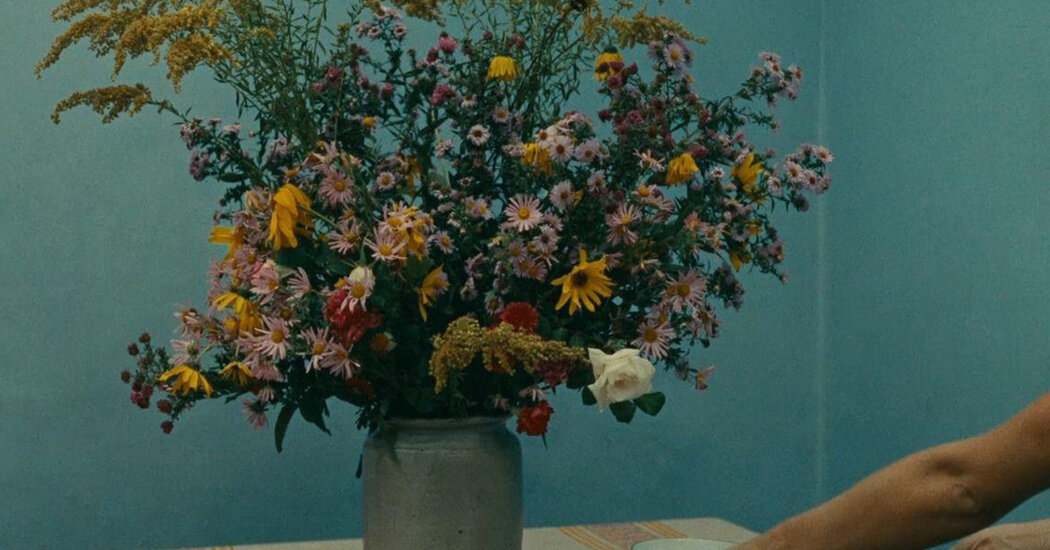
The movie-watching experience usually occurs at a remove from nature: in an air-conditioned theater, at home on the couch, on a trans-Atlantic flight. But directors know that, somehow, film has a way of recreating the transporting feeling that can be gleaned from a landscape — or from a single obsessed-over bloom. Then too, as the visual artist Jenna Gribbon says, “flowers lend themselves easily to metaphor.” A bouquet can foretell sexual awakening or looming despair; a forest might swing from primeval to portentous. To assemble a watch list filled with just this sort of beauty and meaning, we asked 10 creative people whose work abuts the botanical world to share flora-filled films that have made an impression and even informed their own practices.
“Border,” Ali Abbasi, 2018
Katie Stout, 37, artist and designer
I heard about “Border,” by the Iranian-Swedish director Ali Abbasi, through my husband, who has Swedish citizenship. It takes place in a forest, so everything is mossy and lush and wet. The two main characters are border patrol agents who fall in love, and their bodies almost seem to reflect their environment — not in a heavy-handed way, at least not at first. I went in not knowing what to expect, and there’s a major twist. The film explores ideas of gender, nature versus the [civilized] world and what’s beautiful and what’s ugly. In my work, I think a lot about the fine line between beauty and the grotesque. I often create flowers from my imagination or memory, and when I’m talking with glassblowers, I might say, “Let’s make some that are more nefarious-feeling, and then we need some that are more SpongeBob.” I find there’s weirdly a lot of optimism in decay. It leaves room for transformation. And isn’t that the whole point of life, having the opportunity to become other things?
“The Rose Maker,” Pierre Pinaud, 2020
Mandy Aftel, 78, perfumer and author
Everyone should see this movie. It’s about a French rose breeder, Ève Vernet, who has this farm with gorgeous roses, which I also grow. She’s got financial difficulties and ends up hiring three people who’re part of a correctional facility’s rehabilitation program. A young worker of hers named Fred has a wonderful way of describing complex smells — one rose is “like Lipton tea with lemon in it.” And when Ève’s profit-driven rival, Lamarzelle, stops by, Fred says, “I don’t trust that guy. He smells bad, like cigarettes and gum.” Ève asks, “What kind of gum?” And he responds, “Strawberry.” I mean, with a small suitcase, I could’ve moved right into that frame of the movie! I made a perfume because of this film, one that was inspired by my best-smelling rose. It was so thrilling to try to crawl inside the bloom artistically and see if I could capture what nature had made.
“Waiting for Happiness,” Abderrahmane Sissako, 2002
Duro Olowu, 60, fashion designer
I watched this one afternoon at a repertory cinema in London. It’s about a young man who’s come back to his mother’s village in coastal Mauritania. He’s interacting with people he hasn’t seen for a long time, who speak in a dialect he can’t remember. It’s dreamlike, almost like an [Éric] Rohmer film. The terrain is desert meets city. The scenes that made me jolt involve these floral patterns, bursts of color in the dusty atmosphere. At one point, the main character is sitting in a room where everything — the curtains, the table, his shirt — is draped in the same floral. The camera just pans as he’s in this field of yellow. That use of pattern upon pattern is very much how I work with floral motifs in my collections. It’s a reminder of the brilliance of natural color, and it gives your eyes and brain a chance to connect with your heart. You want to feel part of a growth process that’s bigger than you.
“Testament of Orpheus,” Jean Cocteau, 1960
Jenna Gribbon, 47, artist
I first watched Jean Cocteau’s Orphic Trilogy — “The Blood of a Poet” (1930), “Orpheus” (1950) and “Testament of Orpheus” — in college. I think my younger self felt more moved by “The Blood of a Poet,” which centers on the creative process and what art is, whereas there’s a looking backward in “Testament of Orpheus,” a gaining of perspective that I relate to now, as an artist who’s been working for 25 years. Jean Cocteau plays a version of himself, a time-traveling poet, and Cégeste, a character from “Orpheus,” comes back to life and offers him a hibiscus flower. There’s a scene where the poet is at his easel, trying to paint the flower, but keeps accidentally making a self-portrait. Cégeste tells him, “An artist only paints himself.” I feel connected to that challenge of separating the self from the subject. I paint my wife over and over again, and it’s about the difficulty of really seeing someone that you’re close to.
“Le Bonheur” (“Happiness”), Agnès Varda, 1965
Jennie Jieun Lee, 53, ceramic sculptor
During the pandemic, shortly after my boyfriend and I had moved upstate, I started growing flowers in our yard for the bees and birds to pollinate, as a way to be of service to the world. That’s when I first saw “Le Bonheur” on the Criterion Channel. In the film, the flowers are a character of their own. The wife always chooses a diverse bouquet with lots of colors. When the husband begins having an affair with this young postal worker, the flowers at her house are all daisies, which I find quite basic. The title, to me, is about who gets to be happy. The husband tells his wife, “I’ll be happy if I start seeing somebody else,” and, as a people pleaser, she pretends to go along with it, as women do. The director, Agnès Varda, once said the movie is like a peach with a worm inside. I’m growing flowers from seed again, and this year I’m trying to mimic those colorful bouquets in the film with stock, lisianthus and snapdragons.
“The Hours,” Stephen Daldry, 2002
Kyle Abraham, 48, choreographer
There’s so much tension and beauty in “The Hours.” Meryl Streep’s character is trying to get this party together for her friend who’s dying of AIDS, and she wants everything to be perfect, down to the roses and hydrangeas. There are flowers sprinkled throughout the film, including the scenes with Nicole Kidman and Julianne Moore [who play the author Virginia Woolf and a 1950s housewife, respectively, in the movie’s other story lines]. The floral arrangements become part of this conversation around ephemerality and fragility. The scene that sticks with me the most is when Ed Harris, who plays the sick friend, asks Streep, “Who are you throwing this party for?” She says, “Of course it’s for you, Richard.” And he’s like, “Is it?” I think about these questions: Who do you live for? Who do you make art for? And about vulnerability. My show at the Park Avenue Armory [“Dear Lord, Make Me Beautiful” (2024)] was the first one where I was really thinking about my aging body, and ironically, I tore my calf on opening night.
“Edward Scissorhands,” Tim Burton, 1990
Natasha Pickowicz, 41, chef and author
I watched this at a slumber party in fourth or fifth grade. The whole film is a sendup of banal suburban life. As a kid, I was in awe of how Edward Scissorhands transforms this quotidian landscape into something whimsical and fairy tale-like. He intuitively knows what to create, defying those ideas of what a front yard should look like, and his topiaries felt like an exciting revelation. That moment of surprise is something I chase in my pastry work. I remember working in restaurants and putting chicory leaves on cakes because they, to me, mimic the ruffles and folds of actual flower petals. But while I obviously appreciate wilderness and nature, I think my sensibility is actually more about what happens when people intervene with flora. It becomes a conversation between the person and the plant: How are we pulling a story out of raw materials?
“Eaux d’Artifice,” Kenneth Anger, 1953
Dan Pearson, 62, landscape designer
After watching “Eaux d’Artifice,” which was shot in the garden at Villa d’Este in Tivoli, outside Rome, I thought I’d better go because the film is just so magical. Gardens are an interesting medium because you really need to witness them across the shifts in light, time of day, seasons. You move five paces and they’ve changed altogether. This film, even though it’s only 13 minutes long, evokes what it is to be in the grandeur of this place. A whole hillside was made into this garden, and a canal was cut through from the other side of the village to channel the water. There’s no narrative. A figure wearing 18th-century-style garments moves through the place. And there’s no sound except for Vivaldi, more intense in some moments and more rhythmical in others. Kenneth Anger, the director, must’ve filmed it during the day and altered the color, since there’s a silvery blue moonlight effect. There’s a sensuality that comes through, with all the water catching the light.
“Adaptation,” Spike Jonze, 2002
Jonas Wood, 49, artist
When I was growing up, Spike Jonze was such a big deal because of his Beastie Boys and skateboarding videos, so I for sure saw “Adaptation” in the theater. I haven’t read the Susan Orlean book [“The Orchid Thief” (1998)] that it’s partly based on. I only know the version by the [screenwriter] Charlie Kaufman — drugs and sex and car chases. He made a movie about himself trying to write a movie. I love how flowers are depicted in “Adaptation,” often with dramatic lighting. I think of Nicolas Cage [as Kaufman] walking through an orchid show in Santa Barbara, and the photos of rare orchids and bromeliads that Chris Cooper [playing the thief] has pinned up in his nursery. Those images must’ve come back to me in some way, because I love to paint those two kinds of plants. I like to see their uniqueness and make them more abstract than they are.
“Stealing Beauty,” Bernardo Bertolucci, 1996
Nicole Wittenberg, 47, artist
I watched this on repeat when I was 16 and convalescing from back surgery. My parents had gone to pick up movies for me, and when they went to return the tapes, I hid this one because it’s so beautiful. There’s a loose, not really compelling plot about a girl, played by Liv Tyler, who goes to Italy to find her father. I don’t even remember watching it with sound, but I remember the visual sensation — shots of the flowers and trees and hills. There’s one sex scene, and it happens at night outdoors: the idyllic story that everyone wishes was how they’d lost their virginity. The film was totally panned, but the people who worked on it were amazing. Darius Khondji, the Iranian-French cinematographer, also shot “My Blueberry Knights” (2007) for Wong Kar-wai and most recently [Josh Safdie’s] “Marty Supreme” (2025). I’ve been making erotic paintings for years now — sometimes based on strange search queries made on amateur porn sites, like “moonlight” or “Bavarian hike” — and they come out of the feeling of this film, in a way.