Film
1. The supporting cast of ‘The Wizard of Oz’ (1939), directed by Victor Fleming
“The performances that influenced me were always by character actors, the people who populated the world that you sometimes cared more about than the lead actors,” says Stephen Root, 74, known for his supporting roles in the Coen brothers movies “O Brother, Where Art Thou?” (2000) and “No Country for Old Men” (2007). “The original ‘Wizard of Oz’ made a huge impression on me because it was an assembly of the greatest vaudeville actors of all time, like Frank Morgan [who plays the Wizard] and Margaret Hamilton [who plays the Wicked Witch of the West].”
2. Jimmy Stewart in ‘It’s a Wonderful Life’ (1946), directed by Frank Capra
Root singles out the performance of Stewart, as a man contemplating suicide on Christmas Eve, in another stellar ensemble cast, which includes Lionel Barrymore [as the villainous Mr. Potter] and Ward Bond [as Bert the cop]. The actor, Root says, “had been a song-and-dance man in the ’30s, and now he had just come back from the war” — Stewart was one of the first big Hollywood stars to enlist in the army during World War II. Root describes his portrayal of George Bailey as “this psychological demolition of a man.”
3. Bette Davis in ‘All About Eve’ (1950), directed by Joseph L. Mankiewicz
Marcia Gay Harden, 66, who won an Oscar for playing the artist Lee Krasner in Ed Harris’s 2000 biopic, “Pollock,” says that Davis’s role changed how women appeared in films forever after. “Here’s this older, drop-dead-beautiful actress grappling with fame and ambition and aging,” Harden says. “Davis wasn’t trying to be likable. She was playing this powerful woman with a love of barbs and slings.”
4. Paul Newman and Robert Redford in ‘Butch Cassidy and the Sundance Kid’ (1969), directed by George Roy Hill
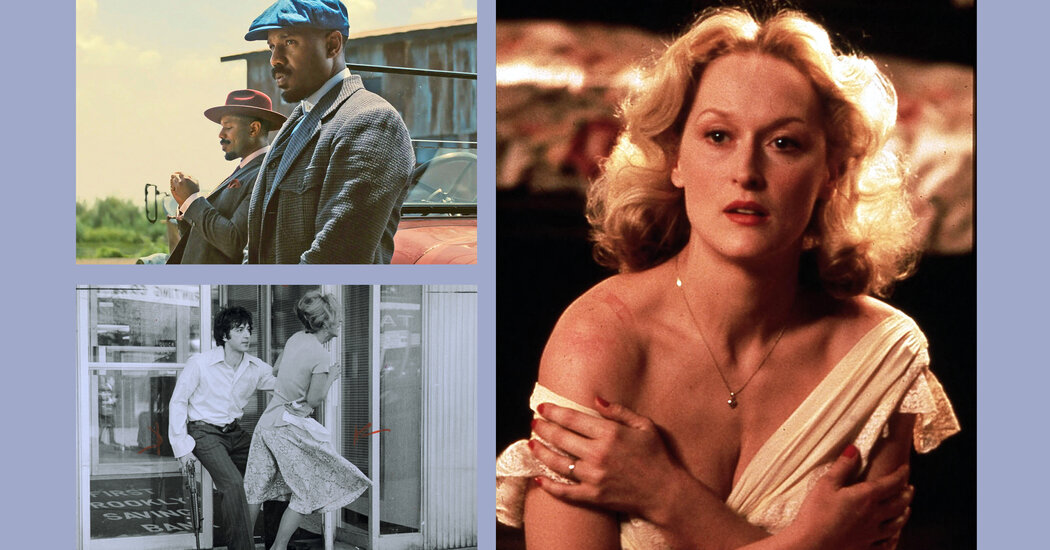
Wendell Pierce, 62, who portrayed Bunk on “The Wire” and Willy Loman in “Death of a Salesman” onstage in London and New York, is always amazed by the dynamic between Redford (shown above at left) and Newman (right), two outlaws on the run. “What makes a performance iconic,” he says, “is that it will speak to someone in the past, speak to someone in the present and speak to someone in the future.”
5. Faye Dunaway in ‘Chinatown’ (1974), directed by Roman Polanski
Root describes Dunaway’s performance as the long-suffering daughter of a corrupt landowner in this film about the fight for water rights in California as particularly formative. “I don’t think there’s anybody who affected me the way that Faye Dunaway did in the ’70s,” he says. “What comes to mind is her being slapped [by Jack Nicholson] in ‘Chinatown.’ I had never seen that kind of angst ever.”
6. Al Pacino in ‘Dog Day Afternoon’ (1975), directed by Sidney Lumet
Watching this portrait of a doomed bank robber, played with chaotic fury by Pacino, trying to get money for his lover’s gender confirmation surgery “was the first time I realized as an actor that there was no acting involved, there is only reacting to situations,” says Root.
7. Meryl Streep in ‘Sophie’s Choice’ (1982), directed by Alan J. Pakula
Streep plays a Holocaust survivor living in Brooklyn, traumatized by decisions she had to make during the war. “I can’t think of another actress who has more prowess than Meryl Streep,” Harden says. “Her performance — from crafting the Polish accent to [even finding] the bits of humor [in the role] — just raised the bar.”
8. James Earl Jones in ‘Fences’ (1987), directed by Lloyd Richards
Jones originated the role of Troy Maxson, the stubborn, scarred but ultimately noble father living in 1950s Pittsburgh who is at the center of August Wilson’s classic play, on Broadway. Though it’s not a film performance, Pierce notes that it can be watched on film at the Library for the Performing Arts at Lincoln Center in New York. “It was absolutely stunning and revelatory,” he says of seeing Jones on opening night in 1987. “When I say ‘revelatory,’ I mean it speaks to our humanity. His performance was so strong and specific that it became universal.”
9. Cynthia Erivo in ‘Wicked’ (2024), directed by Jon M. Chu
Harden says Erivo’s Elphaba, in this retelling of “The Wizard of Oz” from the perspective of the Wicked Witch of the West, once again changed how women are represented in films. Erivo is “playing this major character in a musical that wasn’t written to be a Black woman” and making the part her own. “She took the role to a third level.”
10. Eva Victor in ‘Sorry, Baby’ (2025), directed by Eva Victor
Victor, who also wrote and directed the film, plays a reclusive college professor coming to terms with a sexual assault. “That was a profoundly moving performance because of how the actor drew you in,” says Pierce. “You couldn’t help but feel, no matter who you are, that you knew exactly what that character was going through.”
11. Michael B. Jordan in ‘Sinners’ (2025), directed by Ryan Coogler
In “Sinners,” Jordan, who won an Oscar for his performance, plays twin brothers who work for a criminal empire in Chicago and return home to the Jim Crow South for the first time in years. One of Jordan’s earliest roles was as a child drug dealer on “The Wire,” playing opposite Pierce. “I’m really honored to actually know him because I remember him as a little boy,” Pierce says. “The thing that makes it wonderful is that he plays the twins — who share the same DNA — so different.”
These interviews have been edited and condensed.
More in Film
See the rest of the issue